
-
Learn the Basics
-
- Spaces
- Space Types
- Creating Spaces
- Adding Users to Spaces
- Space Activity Stream
- Following Spaces
- Space Details
- General Space Settings
- Duplicating Spaces
- Renaming Spaces
- Changing the Space Color and Icon
- Removing Users from Spaces
- Closing and Restoring Spaces
- Moving Spaces between Different KanBo Environments
- Deleting Spaces
-
- Creating Cards
- Following Cards
- Scheduling Cards
- Renaming Cards
- Duplicating Cards
- Quick Actions
- Mass Actions
- Copy & Paste
- Archiving Cards
- Adding Cards to MySpace
- Adding Mirror Cards
- Removing Mirror Cards
- Moving Cards between Spaces
- Deleting Cards
- Removing Cards from MySpace
- Hinzufügen von Karten zu "MySpace"
- Entfernen von Karten aus "MySpace"
- Hinzufügen von Status
-
Visualize Work
-
- Space Views
- Creating Space Views
- Personal and Shared Space Views
- Card Grouping
- Filtering Cards
- Display Settings
- Work Progress Calculation
- Grouping Description
- Card Grouping Settings
- Changing the Order of Groupings
- Changing the Order of Space Views
- Deleting Space Views
- Following Card Statuses and Custom Fields
-
-
Collaborate
-
Level Up Your Work
-
Work Securely
-
Integrations
-
- Advanced KanBo Actions in Power Automate
- Creating KanBo Space Attached to Subfolder Created by Power Automate
- Creating Document Folders in Document Libraries Created by KanBo with Power Automate
- Exporting Space Views to Excel
- KanBo and Azure Logic Apps Integration
- Power Automate Integration: Triggers and Actions
- Seamless Import from Microsoft Planner to KanBo
- Synchronizing KanBo with Outlook Calendar
- Using KanBo Outlook App
-
Dates in Cards
This post is also available in: Deutsch
In this article:
Overview
Dates in cards are the specific terms associated with individual cards within a space. They represent important milestones, deadlines, or durations associated with a particular card.
You can add four types of dates to your card:
 Start Date – allows you to indicate a date to start your task.
 Due Date – stands for the final term of completing a card.
 Card Date – can be handy to appoint milestones in your project or any events which appear through completing work on a card.
 Reminder – this date is only visible to the user who created it.
Adding dates to your cards allows you to place your tasks in time. You can set an exact time-frame for completing work by creating a start date and due date on a card. These features help you manage your workload.
Dates are one of the card details. You can find it on the left side of a card.
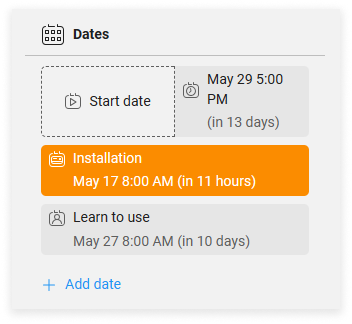
Example: Card dates in the card details section. This card has a due date of May 29, an Installation card date of May 17, and a Learn to use reminder of May 27.
Card dates change their color as the deadline approaches.
Card dates and your reminders are marked on the space timeline with dots.

Working with card dates
See how to add dates to cards to take advantage of more advanced tools KanBo provides. Visualize tasks over time to better schedule your work.
Space views focused on card dates:


Use calendar view for short-term tasks. Gantt Chart and Timeline views are perfect for long-term ones.
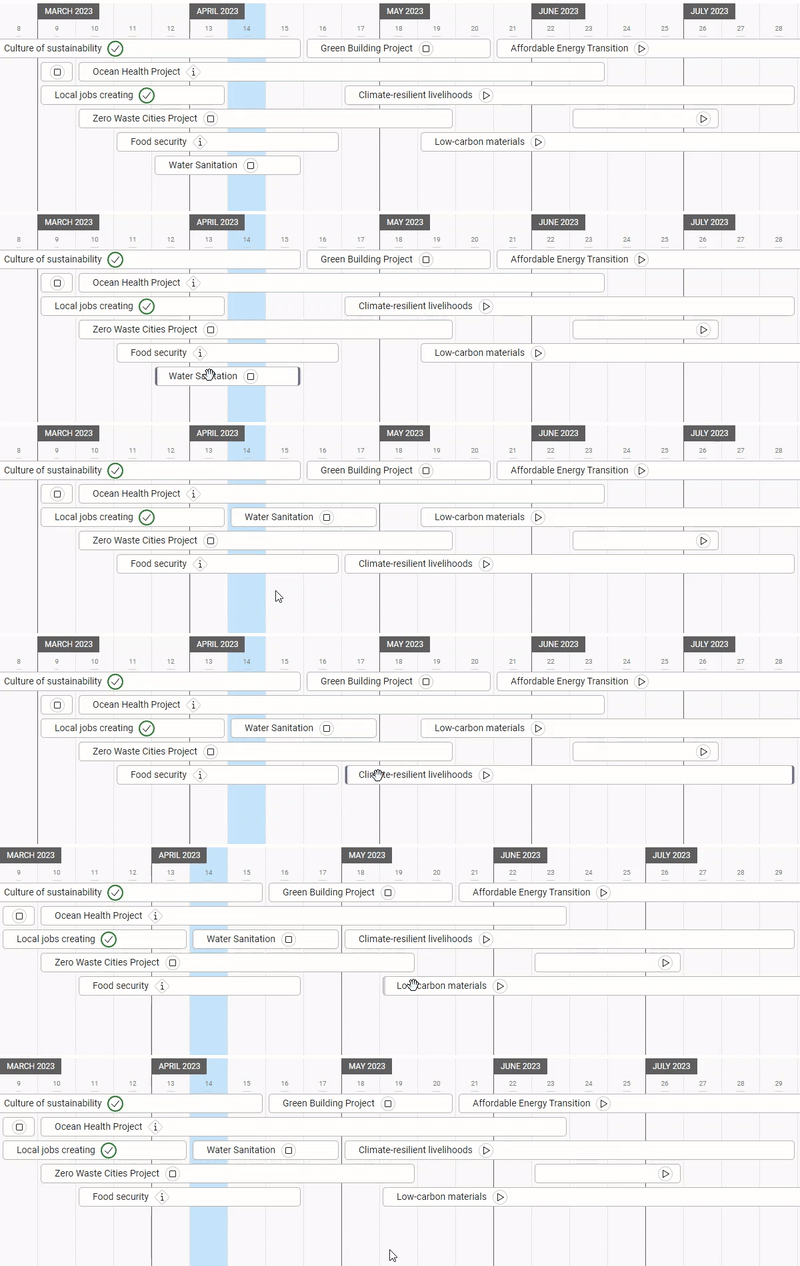
Example: Card dates visualized with the Timeline view.
Card dates notifications
Time conflict issues arise when there are conflicts or discrepancies in the timing or scheduling of card-related activities. They are highlighted with the orange exclamation mark on a card front to draw attention to potential delays.

As the deadline approaches, the information about it is displayed in the card and space activity stream. If you are following the card or space, you will be notified about it.
Frequency of reminders about the upcoming date:
| 5 days before | 1 day before | on time | |
|---|---|---|---|
| Start date |
– |  |
|
| Due date |
|
|
|
| Card date |
– | – | |
| Reminder |
– | – | |
Dates are highlighted in:
- Orange – if there is less than a week left to go.
- Red – if the deadline has been missed.
The reminder is the only date that leaves no trace in the activity stream. Only the person who set the reminder can see it and can be notified about it.
FAQ
How can I add a date to a card?
Follow the scheduling cards guide for information about adding, editing, and deleting dates to cards.
Can I turn off the notification sound?
You can turn the sound on or off by toggling the sound option in the notification settings.
Can I get email notifications from KanBo?
Yes, you can enable email messages about unread notifications in KanBo. Please note that an email message will only come if the notifications have not been read in KanBo. If you are active in KanBo and read notifications on a regular basis, you will not receive an e-mail about them.
Can I visualize cards with dates in a form of calendar?
Yes, use Calendar view for the classic way of presenting time or Gantt Chart view to see more time dependencies between cards in a long-term form. Try also our new Timeline view if you need to focus on organizing the order of tasks.
Was this article helpful?
Please, contact us if you have any additional questions.